I’ve been a Bitcoin fan for a while now. Not because ‘number go up’ (which is interesting too, if you like money) - but much more so because of its significance for the energy transition. Bitcoin mining/transaction processing is essentially a mechanism to convert electricity to money.
Being able to convert electricity to money and move it around is very useful. We’re heading for a future where there will be massive over supply of electricity at times, mainly from solar PV.
To keep solar PV economic / profitable, the worst thing you can do it not have a customer for the electricity it produces (obviously).
When there’s an excess of solar PV on the grid, prices will be negative, meaning solar PV will be switched off - so exporting to the grid won't be an option at peak times.
If you have solar PV located beside a factory or something else that can use the electricity locally, that’s great - but not many industrial processes or homes can ramp up their consumption in response to excess solar PV generation (EpiSensor is working on that, by the way!).
The other option you have is to charge a battery and discharge it at a later time, either to the grid or into your site load. That’s fine, but battery cost probably needs to drop by another order of magnitude for that to be the default option, and even then you need to consider wear/depreciation of the asset.
What other options do we have to make use of excess renewables…?
This is where I think Bitcoin mining/transaction processing can be a super interesting component of the energy transition.
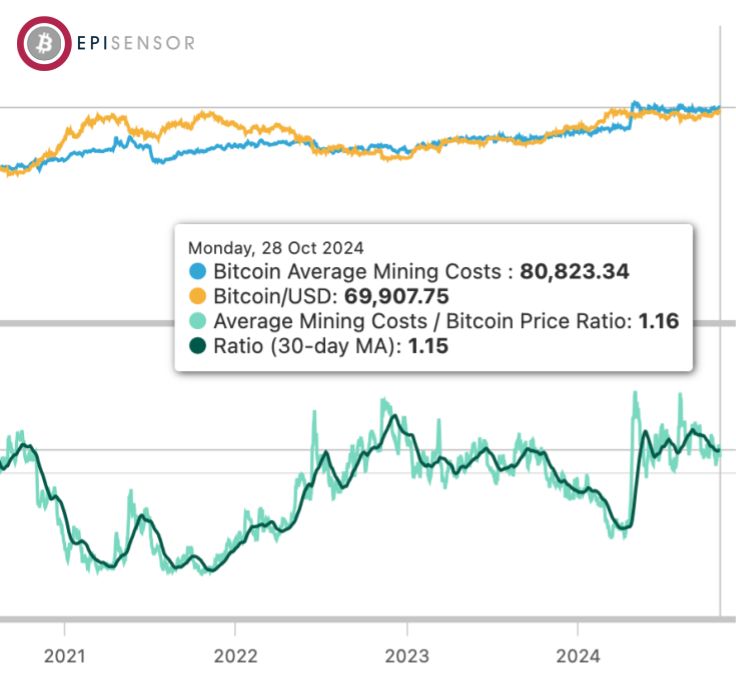
The graph attached shows average Bitcoin mining cost over time. You can see that right now, the cost to mine Bitcoin is very similar to the price Bitcoin trades at, and that’s been fairly consistent over time because of the mining difficulty adjustment, which happens every 2 weeks or so.
The cost to mine Bitcoin has two main components - the capital cost of the mining rigs, and the energy cost. The miners use application-specific processors (ASIC) which are very good at doing one type of calculation - generating SHA-256 hashes. Guess the right hash (like a fingerprint for a block of transactions, you get the prize). The ASIC’s not particularly complex silicon, the marginal cost is low, and the material cost is low - so if there’s sufficient volume / demand, there’s no reason for them to be expensive.
I think there should be a lot more work going into making use of ASIC’s (colocated with renewables, and ideally where the heat is being made use of) to address the problem of excess solar PV production.
It makes so much sense to me to have a Bitcoin mining ASIC submersed in a water tank, powered by solar PV, raising the temperature of the water for use later. If you’re working on that, consider EpiSensor’s IoT infrastructure for monitoring solar PV output power, receiving price signals from grid operators, dispatching the ASIC and monitoring temperature/performance. We have all the components you need!