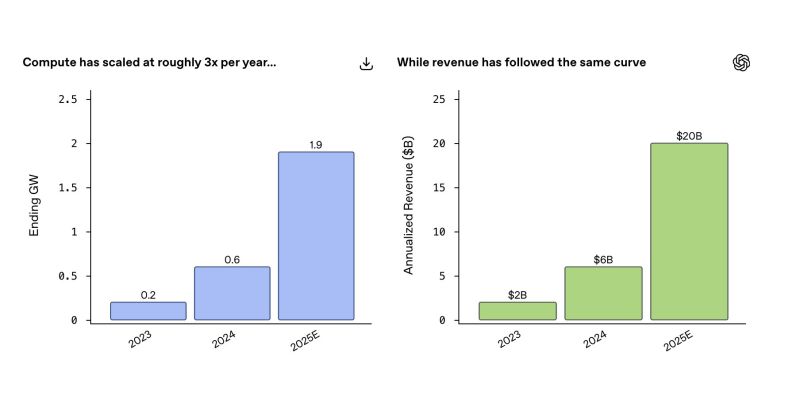
1) Look at this graph from the recent OpenAI earnings report / blog post
2) The directional signal is clear: power demand is scaling quickly, and revenue appears tightly coupled to available compute.
3) Environmental externalities are not irrelevant; they are part of the constraint set. But economically, this is still a strong demand engine for power.
4) More coins will be inserted into that machine.
5) Countries and large firms will compete aggressively for compute and generation capacity because energy + intelligence increasingly drives competitiveness.
6) Latent capacity is being consumed. If demand rises faster than grid upgrades, reliability events become more likely.
7) Virtual Power Plants are still niche, but I do not see a credible high-AI-demand scenario where they stay optional. Grid operators will need dispatchable flexibility to flatten peaks and protect reliability.
In other words, if Germany's peak demand is ~90GW, but average demand is ~60GW, the grid still has to be built to serve peak demand. There's 30GW to play with that can be unlocked without adding any new power plants or storage.
How would it be done? Mandate or incentivise large flexible loads to enrol in VPP programmes, so grid operators can curtail demand quickly when needed.
Disclosure: EpiSensor builds technology in this category.